
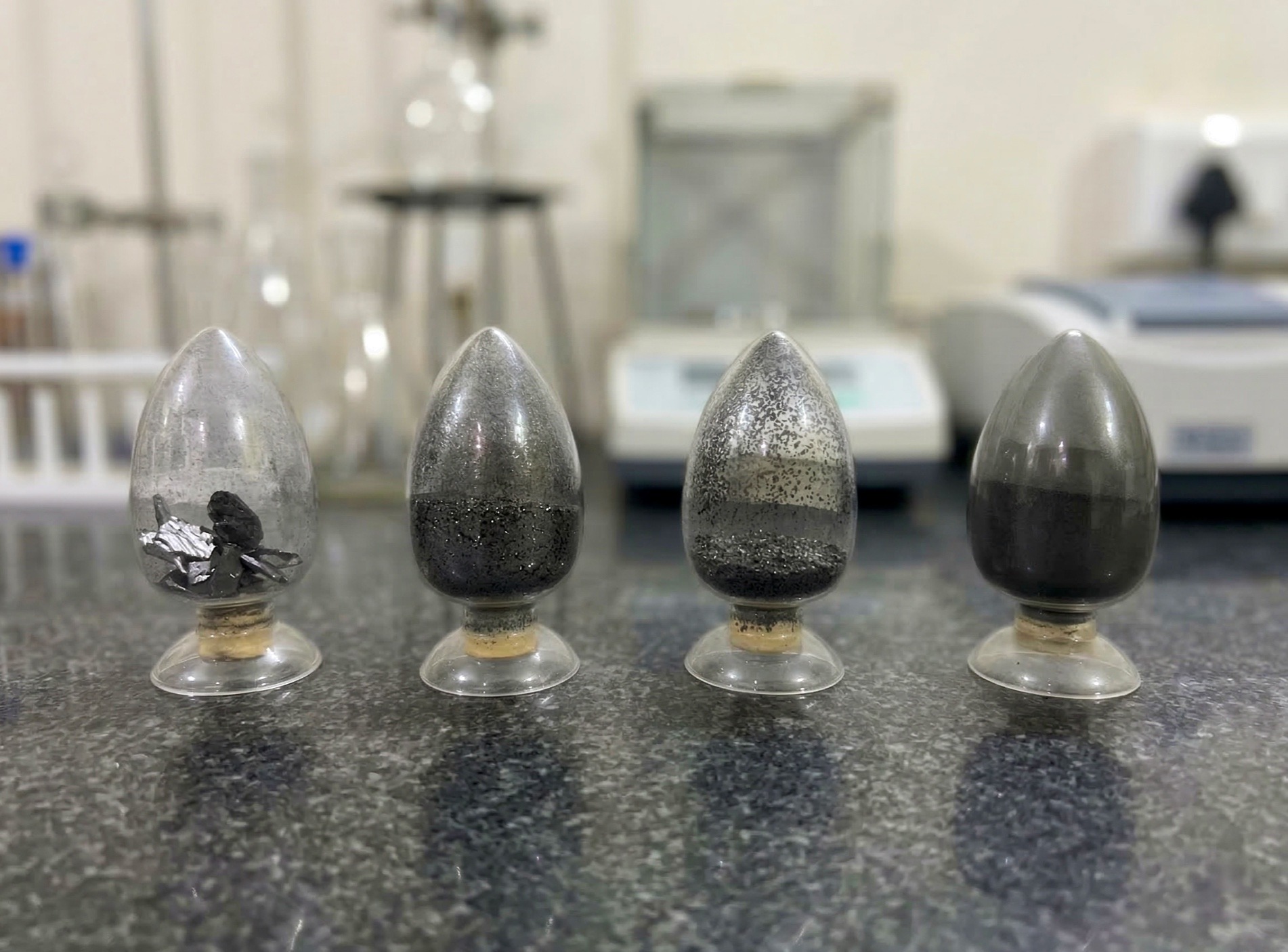
f you’ve spent any time sourcing natural flake graphite, you’ve probably come across grade codes like -888, -892, or -894. They look like arbitrary numbers, but they’re not. Once you understand the notation, you can read the spec at a glance.
The three-digit code explained
Natural flake graphite from Chinese and African suppliers is commonly specified using a three-digit shorthand. The first digit refers to the mesh size used to classify the particle — in this case, 8 stands for 80 mesh. The last two digits are the fixed carbon content as a percentage.
So:
- -888 = 80 mesh, 88% fixed carbon
- -892 = 80 mesh, 92% fixed carbon
- -894 = 80 mesh, 94% fixed carbon
The minus sign (-) in front means the particles pass through the stated mesh — finer than that size. All three grades are the same coarse flake size. The only variable is purity.
Why does that distinction matter?
Because the two parameters — particle size and carbon content — drive different things in practice.
Particle size determines how graphite behaves physically: how it packs, flows, mixes with other materials, and interacts with surfaces. For most industrial applications in this 80-mesh range, you’re working with coarse flake, which gives you good thermal conductivity, decent lubricity, and strong structural contribution in composite materials.
Carbon content — or fixed carbon — determines chemical purity. The remaining percentage after carbon is ash: silicates, metal oxides, iron compounds, and other mineral matter that got pulled along during beneficiation. Lower carbon means more of this impurity load, which can affect how the graphite performs in end-use.
Where each grade typically ends up
-888 (88% carbon) is a workhorse grade. The ash content is relatively high at 12%, but for applications where the graphite is eventually exposed to very high temperatures — blast furnace linings, for instance — much of that impurity burns off anyway. It’s also used in foundry mold coatings, basic carbon raisers in steelmaking, and lower-grade lubricants where cleanliness isn’t critical. Buyers choosing -888 are generally optimizing for volume and cost-effectiveness over performance.
-892 (92% carbon) hits a useful middle ground. The lower ash load makes it suitable for friction materials like brake linings, higher-quality foundry coatings, industrial greases, and as feedstock for expandable graphite — which requires reasonably clean flake to expand uniformly. A lot of mainstream industrial demand sits at this level.
-894 (94% carbon) starts to show up in more demanding applications: better-quality crucibles, specialty refractories, higher-grade lubricants, and as a cleaner input for further purification processing. Manufacturers who need to refine graphite beyond 97% will often prefer to start with 94% material because less impurity going in means less processing work and better yield going out.
A note on flake integrity
One thing worth paying attention to, which the grade code doesn’t tell you: how well the flake structure has been preserved during beneficiation. Two bags of -892 can look identical on paper but behave differently in a refractory mix depending on how aggressively the ore was processed. Large, intact flakes conduct heat better and interlock more effectively in refractory matrices than fragmented flake of the same carbon content. It’s worth asking suppliers about flake size distribution within the grade, not just the mesh and carbon numbers.
Reading the certificate of analysis
When you receive a CoA for any of these grades, the numbers to check are: fixed carbon (%), moisture (%), ash (%), and volatile matter (%). Fixed carbon is calculated as 100 minus the sum of the others. A well-run supplier will have consistent CoAs across batches — wide variation in carbon content from lot to lot is a red flag regardless of what grade is on the label.
For refractory and crucible applications, also ask about iron content specifically. Iron impurities can accelerate oxidation at high temperatures and contaminate the melt in some foundry scenarios.
The bottom line
These grade codes are practical shorthand developed over decades of trade between graphite producers and industrial buyers. They’re not a complete specification on their own — you still need to look at the CoA, understand the flake size distribution, and verify consistency — but they give you a fast first read on what you’re looking at and whether it’s likely to fit your application before you go any further.